
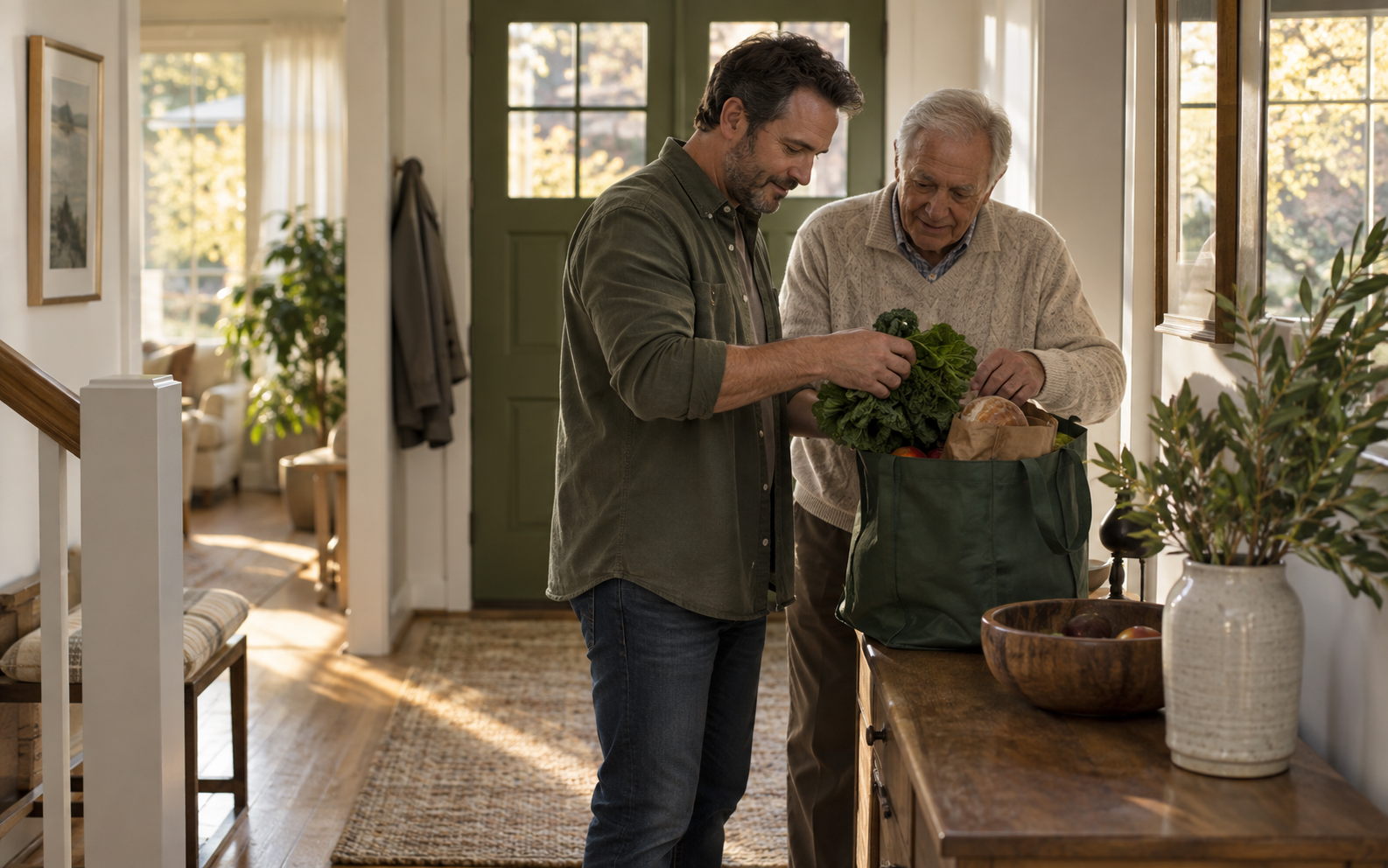
The house is only one part of staying home.
Layout, stairs, bathroom, lighting and daily setup.
Family, neighbors, paid help and emergency contacts.
Appointments, groceries and community access.
What changes the plan after a fall, illness or caregiver loss?
Quick answer
The goal is not to buy the maximum amount of help. It is to identify the smallest reliable plan that solves the current gaps. In Hilton Head and Bluffton, aging in place is sustainable only when the home, transportation, healthcare access, daily routines and backup coverage work together. The goal is to identify the part of daily life that needs support first, then compare the most practical next step.
Hilton Head / Bluffton has a verified median household income of $86,573, median home value of $455,600, and homeownership of 75.9%; use as private-pay/aging-in-place context, not proof that any individual household can afford care. Use these figures as context, not as a prediction of what one household needs.
Aging in place is a system, not a slogan
Aging in place depends on the home, the local travel pattern and the range of community/home supports:
- Housing and household context. Hilton Head / Bluffton has a verified median household income of $86,573, median home value of $455,600, and homeownership of 75.9%; use as private-pay/aging-in-place context, not proof that any individual household can afford care.
- Travel / routing friction. Very high island/resort routing friction: bridge dependence, seasonal traffic, gated communities and dispersed Bluffton/Hilton Head assignments can materially erode caregiver utilization without tight zones.
- Local aging context. Hilton Head / Bluffton uses a verified market profile of 204,433 people with 31.2% age 65+, 11.8% age 75+, and 2.5% age 85+ (geography/proxy basis documented in the master local research).

What the home must support
Aging in place usually fails at the weak link, not at the slogan. Transportation may fail before personal care does; stairs may become a problem before meals; family coverage may become unreliable before the older adult wants to move. Planning should identify those weak links early.
Local planning in Hilton Head and Bluffton around Retirement care; long-distance family; spouse respite. The family should turn that broad market context into a short list of tasks, timing constraints and backup needs that can be tested in real life.
Transportation and healthcare access
Home-based support can make daily life more workable, but it cannot make every home or every level of need appropriate indefinitely. The family should preserve the option to compare a different setting without framing a move as a failure.
Very high retirement/resort signal: Hilton Head and Bluffton combine an exceptionally senior-heavy Beaufort County base, affluent resort/second-home households and long-distance-family care coordination. Very high island/resort routing friction: bridge dependence, seasonal traffic, gated communities and dispersed Bluffton/Hilton Head assignments can materially erode caregiver utilization without tight zones. That local context helps families ask better questions about scheduling, access and the level of support that may be needed.
The daily support stack
Build the home plan around predictable weak points and backup options.
1 Walk the home for safety and access barriers.
2 Map meals, transportation, medications, household tasks and social connection.
3 Add help before a single weak link becomes a crisis.
4 Revisit whether the home is still the best setting.
The value of the sequence is that it produces something the family can observe. If the plan is not solving the actual gaps, change it rather than adding hours or complexity by default.
Home modification and community resources
- What makes the current home easy or difficult to live in?
- How will transportation work if driving stops?
- What combination of family, community and paid help keeps the plan sustainable?
Ask for clear answers about scope, scheduling and responsibilities, and verify clinical or licensing questions with the appropriate source.
When home stops being the best fit
Aging in place should be re-tested when stairs, transportation, cognition, caregiver availability or the cost/intensity of support materially changes.
Frequently asked questions
What makes the current home easy or difficult to live in?
Start with the specific problem behind the search for aging in place and the times it occurs. That prevents the family from buying a broad solution for a narrow problem.
How will transportation work if driving stops?
Verify address-specific resources, the provider's written scope, and any eligibility or clinical requirement that affects the plan in Hilton Head and Bluffton.
What combination of family, community and paid help keeps the plan sustainable?
Use clinicians or emergency services for diagnosis, treatment, medication decisions, new medical symptoms or urgent safety concerns. Non-medical support should stay within its appropriate role.
Next step
Before the next conversation, write down the current gaps, when they occur, the people or resources already involved, and the questions that still need an answer. That turns a broad concern into a usable planning brief.
Talk Through Your Care Needs. Service availability, timing, pricing and exact task scope should be confirmed for in Hilton Head and Bluffton.