
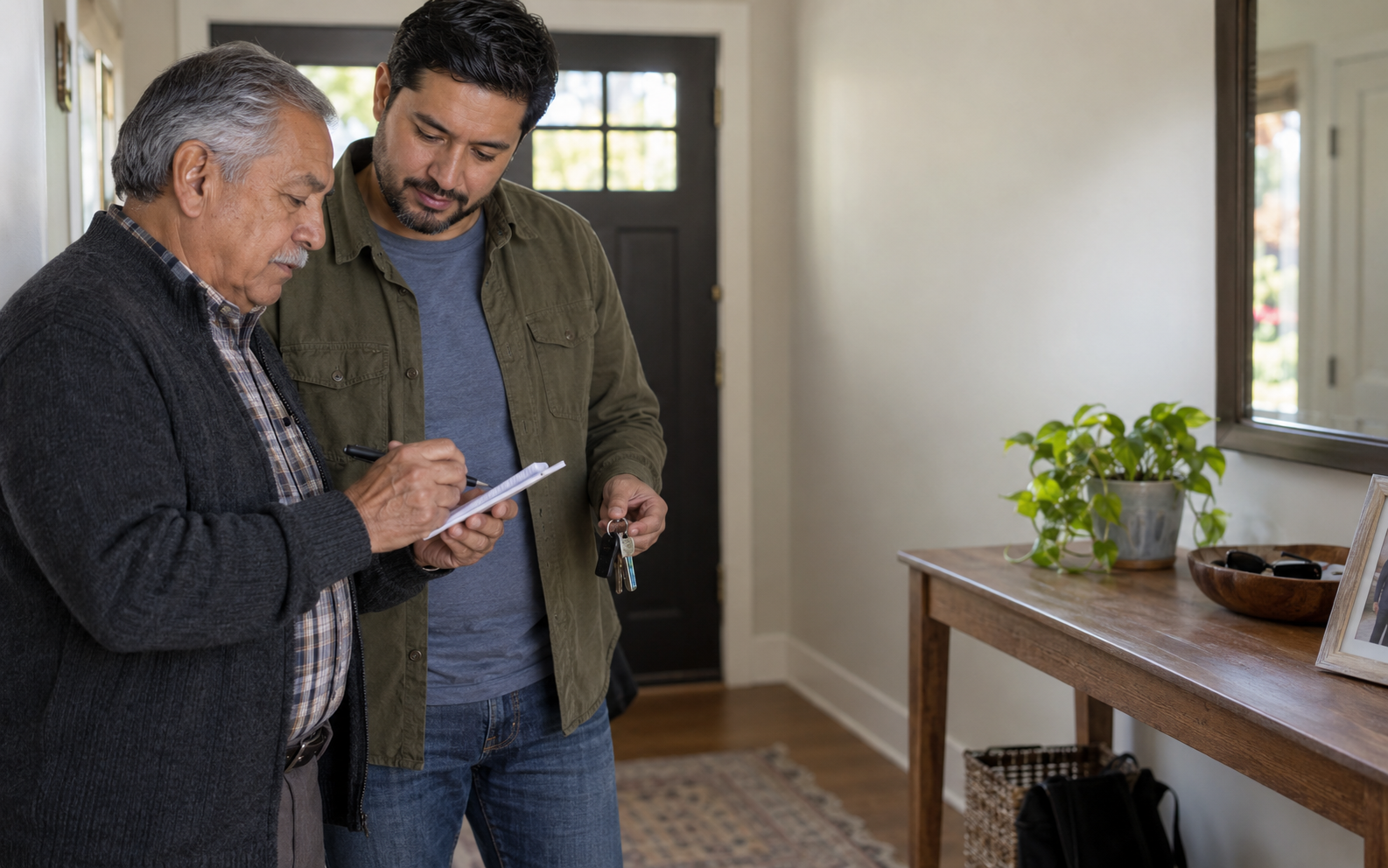
If everyday routines in Boise / Eagle are becoming harder to cover reliably, start with the exact times and tasks that are slipping before deciding how much outside help to add.
What in-home senior care can — and cannot — do
Non-medical in-home care is usually most useful when the problem is not a need for hospital-level treatment, but a need for dependable help with everyday life. Families may be trying to cover companionship, meal preparation, light household routines, errands, supervision, reminders, personal routines or simply another set of eyes in the home. The exact services a provider may offer depend on its policies, the caregiver's role and applicable rules.
That is different from skilled home health, nursing, physical therapy or medical treatment. A family leaving St. Luke's Rehabilitation Hospital or a Saint Alphonsus rehabilitation program may need both kinds of support at different points: clinical services from licensed professionals, and non-medical help with the routines that make recovery at home manageable. A good plan keeps those roles separate instead of treating all 'home care' as the same thing.
Boise and Eagle have different aging contexts
Current Census QuickFacts data show why a single generic Treasure Valley paragraph is not enough. Eagle reports 24.3% of residents age 65 or older, while Boise City reports 16.2%. Boise is also much larger, with a July 1, 2025 population estimate of 238,429.
For families, the practical point is not that one city automatically 'needs more care.' It is that the local care conversation can look different. In Boise, routes may cross neighborhoods such as the North End, East End, Warm Springs Mesa, Southeast Boise, Harris Ranch and West Bench. In Eagle, older-adult transportation and a more senior-heavy population make aging-in-place planning especially relevant. The right schedule should be built around the actual home, family availability, appointments and daily routines — not a citywide stereotype.
After a hospital or rehab stay
Boise has meaningful rehabilitation infrastructure. St. Luke's Rehabilitation Hospital provides inpatient rehabilitation, including care for people recovering from conditions such as stroke, spinal cord injury and brain injury. Saint Alphonsus also operates physical medicine and rehabilitation services and multiple rehabilitation locations in Boise.
For a family, discharge is often when practical gaps become obvious: who will prepare meals, help with errands, stay with a parent during vulnerable parts of the day, keep the home routine organized, or help the family coordinate around follow-up appointments? Non-medical home care can be part of that practical support plan, but it should never be presented as a substitute for prescribed nursing, therapy, medication management or other clinical care. Families should follow the discharge team's instructions and use home care only for the non-medical role it is actually meant to fill.
Transportation can change the care plan
Driving is a major part of independence in the Treasure Valley, but families do have public options worth knowing about. Valley Regional Transit's Access program is ADA paratransit for people who cannot use the regular transit system because of disability. It generally serves areas within three-quarters of a mile of qualifying fixed routes, requires certification, and uses advance reservations.
For Eagle and the broader region, VRT's Beyond Access program is especially relevant. VRT describes it as a no-cost, door-to-door shared-ride option for older adults and people with disabilities in designated parts of Ada and Canyon counties, and Eagle is listed among the communities served. Address-level coverage and qualification still need to be confirmed directly with VRT.
Transportation should be treated as its own planning question. A caregiver is not automatically a medical-transportation provider, and families should not assume every home-care company transports clients.
Local resources families can use even before hiring care
The Southwest Idaho Area Agency on Aging — Area 3 — is one of the strongest starting points for families in Ada County. It connects older adults and caregivers with information, caregiver support, meals, homemaker services, respite, senior-center programs, transportation and other aging supports through the regional network.
Eagle's city Senior Center gives older adults a local community anchor with recurring classes, activities and events. Boise has its own city resource in the Dick Eardley Senior Center. These programs matter because a good aging-in-place plan is rarely just 'hire more hours.' Social connection, transportation, meals, caregiver support and public programs can sometimes solve part of the problem more efficiently.
For Veteran families, VA Boise Health Care also operates a Caregiver Support Program that helps caregivers connect with VA services, benefits and local resources. Eligibility for any specific VA program should be confirmed directly with VA.
What does home care cost in Boise?
There is no single Boise/Eagle hourly rate that applies to every provider or care situation. As a market-context reference, Care.com reports an average starting rate of $27.38 per hour for home-care providers in Boise as of September 2026. That is a marketplace-reported starting-rate benchmark — not a quote from this company, not an agencywide market average, and not a promise of what a family will pay.
Actual cost can change with the level of help needed, length and timing of visits, overnight or weekend schedules, caregiver supply, provider model and whether services are private pay or tied to a benefit program. Families should ask any provider for a written explanation of rates, minimum visit length, cancellation rules, overtime/holiday treatment and what is included before comparing options.
When home care may not be enough
Remaining at home is not always the safest or most practical answer. A family should reconsider the plan when the person's needs routinely exceed what non-medical support can safely cover, when clinical needs are not being met, when the home environment cannot reasonably be made safe, when around-the-clock coverage is not operationally or financially sustainable, or when the older adult would benefit from a different care setting.
Idaho regulates Residential Assisted Living Facilities through the Department of Health and Welfare. Families comparing home care with assisted living can use the state's facility and agency search tools as part of their diligence. A neutral comparison should look at supervision needs, medical needs, social preferences, housing, transportation, family proximity, total cost and what level of support is realistically available at home.
How to evaluate a Boise or Eagle home-care provider
Ask specific questions instead of relying on broad marketing claims:
Questions to ask a provider
- Which Boise and Eagle areas do you actually serve today?
- What kinds of non-medical tasks are included, and what is outside your scope?
- How do you handle caregiver call-outs and schedule changes?
- Are there minimum visit lengths or different rates for nights, weekends or holidays?
- What screening, supervision, training and insurance standards can you document?
- Can the provider explain how it works alongside home health, hospice, rehabilitation or a physician's plan without pretending to replace them?
- What happens if the client's needs increase beyond what the caregiver can safely handle?
The strongest answers should be specific and documentable. If a provider cannot clearly explain its boundaries, pricing structure or backup process, keep comparing.
Common questions
Is in-home senior care the same as home health? No. Non-medical home care focuses on daily-life support, while home health involves skilled clinical services ordered and delivered under medical rules. A family may use one or both depending on need.
Does Valley Regional Transit serve older adults in Eagle? VRT lists Eagle among communities served by Beyond Access, a regional shared-ride program for older adults and people with disabilities. Qualification and address-level coverage should be confirmed with VRT.
What public resource should an Ada County family call first? Southwest Idaho Area Agency on Aging (Area 3) is a strong starting point for aging-services information and referrals across Ada County.
How much does home care cost in Boise? A September 2026 Care.com marketplace benchmark reports a $27.38/hour average starting rate for Boise providers. Treat that only as market context; actual provider rates and minimums can differ substantially.
When should assisted living enter the conversation? When supervision, safety, social needs, clinical complexity or the cost of sustaining support at home make a residential setting worth comparing. Idaho DHW's facility search is a useful diligence tool.
Ready to think through the next step?
A care conversation should start with the real situation: what your parent can still do independently, where the gaps are, what family members can reliably cover, what the discharge or medical team has recommended, and what kind of schedule is sustainable.