
Do not buy the maximum amount of help by default.
What part of daily life is actually failing?
When does it happen often enough to need reliable coverage?
What happens when the usual family helper cannot cover it?
Which needs belong to a clinician rather than household support?
Quick answer
In-home support becomes worth exploring when ordinary routines are taking more coordination than the family can sustainably provide. The first job is to identify the specific gaps rather than shopping for a vague amount of “care.”
For a family in Ponte Vedra, Nocatee and St. Johns County, the point of this page is to turn a broad concern into one practical decision, using local evidence without pretending every household needs the same answer.
One way to make this concrete in Ponte Vedra, Nocatee and St. Johns County: put the family’s concern next to the local context. Across the broader local market, 306,934 people with 21.1% age 65+, 8.3% age 75+, and 2.0% age 85+. Median household income is $109,839, median home value is $489,200, and homeownership is 82.2%. Those figures help frame private-pay and aging-in-place decisions, but they do not tell us what any one family can afford.
What matters locally
Local conditions do not decide care for a family, but they do change the practical options worth comparing. Around Ponte Vedra, Nocatee and St. Johns County, families are making this decision in the context of aging parents in fast-growth master-planned communities; that changes which alternatives and logistics deserve attention first.
- Older-adult context. Across the broader local market, 306,934 people with 21.1% age 65+, 8.3% age 75+, and 2.0% age 85+.
- Housing and household context. Median household income is $109,839, median home value is $489,200, and homeownership is 82.2%. Those figures help frame private-pay and aging-in-place decisions, but they do not tell us what any one family can afford.
- Local family pattern. Local planning commonly involves aging parents in fast-growth master-planned communities as recurring family-care themes in Ponte Vedra, Nocatee and St. Johns County.
- Hospital and rehabilitation context. Very strong Jacksonville Beaches / St. Johns referral depth: Baptist Medical Center Beaches provides hospital-based emergency, medical, surgical and rehabilitation services; Brooks Rehabilitation adds outpatient clinics in Ponte Vedra Beach and Nocatee plus intensive inpatient rehabilitation hospitals at University and Bartram campuses.
- Scope boundary. A private-pay organization limited to homemaker/companion services may operate under Florida AHCA Homemaker & Companion Services registration, but that registration does not authorize hands-on personal care. If the service model includes bathing, dressing, eating, hygiene, transfers, ambulation or other hands-on ADL assistance, the operator must use an appropriately licensed home health agency or nurse registry model. Personal-care scope: HCS registrants may provide housekeeping, cooking, errands and companionship but may not provide hands-on personal care. Florida defines personal care to include assistance with ADLs such as dressing, bathing, eating, hygiene, transfers, ambulation and permitted medication assistance.
Local logistics. Moderate-high coastal/suburban routing friction: the cluster stretches across Ponte Vedra, Nocatee and St. Johns County with A1A, US-1 and access toward Jacksonville/Bartram. Fast residential growth, bridges/coastal weather and cross-county assignments make zone-based caregiver scheduling important.
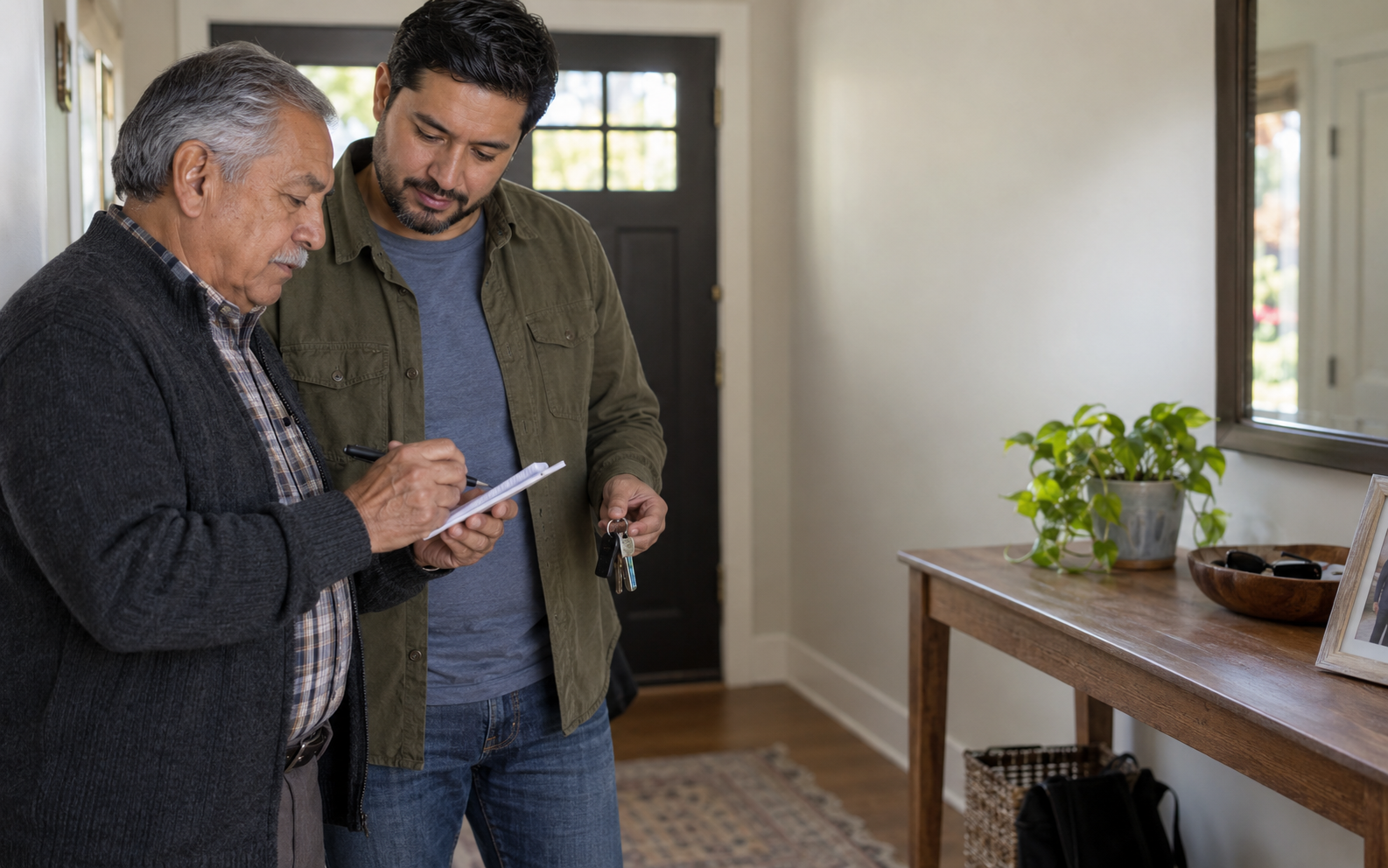
How to make the next decision smaller
The family can make the decision smaller by working through four steps:
1 Start with the week, not a service menu. Write down the moments that currently require family rescue: mornings, meals, bathing or dressing routines, appointments, evenings, medication organization, housekeeping, or simply being alone too long.
2 Separate non-medical help from clinical care. A home-care conversation should not replace a doctor, nurse, therapist, home-health agency, or emergency plan. If the need is skilled or clinical, route it to the appropriate licensed provider.
3 Choose the smallest useful starting schedule. A good first schedule covers the hardest recurring windows. It can be expanded later if the real pattern shows that more support is needed.
4 Build a review point. After the first week or two, look at what actually improved and what remained difficult. That is more useful than guessing at a permanent schedule on day one.
Test the plan against a hard day: ask what would happen if the primary family helper were unavailable for 48 hours. The answer often reveals which part of in-home senior care needs to be solved first.
Know what kind of help you are looking for
Use this page as a planning guide, then confirm provider-specific details directly before making a care decision.
That boundary belongs in the decision itself. It tells the family which needs can stay in a non-medical plan, which fit a public or community resource, and which require a licensed clinical professional.
Before choosing a provider or program
A short provider interview should cover at least:
- Which daily routines are the hardest right now?
- What does the family currently cover, and which parts are no longer sustainable?
- What tasks would require a different license or clinical provider?
- How will the plan be adjusted if needs change?
The answer should be concrete enough to change the plan. If scope, timing, escalation, eligibility or what happens when needs change is still vague, the family still has an unresolved decision.
Questions families commonly ask
Should we start with as many hours as possible?
Usually the better first move is to cover the highest-friction windows and review the pattern. A larger schedule only makes sense when the actual needs support it.
Is in-home senior care the same as home health?
No. Non-medical support and skilled home health are different categories. Clinical nursing, therapy and medical treatment belong with appropriately licensed healthcare providers.
How do we know if it is time to consider in-home care?
Look for recurring gaps rather than a single bad day: missed meals, unsafe routines, repeated family call-outs, difficulty getting to appointments, or growing strain on the person who has been compensating.
Useful next steps
The page should hand the reader to the next relevant question through Senior Care Guide | Cost of Home Care | How Much Care Does My Parent Need? | Aging in Place; unrelated sibling pages stay out of the module.
Turn this into one next decision
The family does not need a perfect care plan before it can make progress. It needs a clear first decision, truthful boundaries and a way to revisit the plan as needs change.
Talk Through Your Care Needs